Blockchain Games to Earn Money: What Players Actually Earn
7 min read
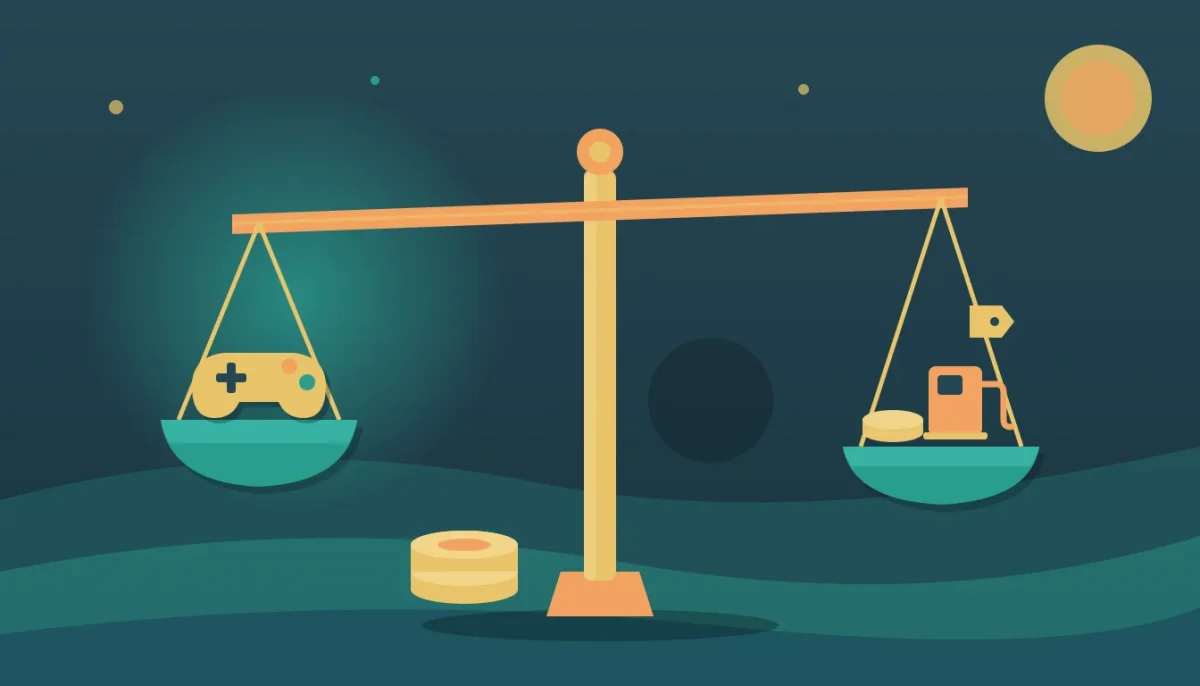
Do crypto games pay real money? Some do, in tokens that can be swapped for cash. But “pays” is not “profits”: after fees, entry costs and price swings, many players earn nothing or lose money. Treat any payout as the result of a mechanism you can inspect, not a wage.
Key takeaways (last reviewed November 2026)
- Rewards are paid by someone: other players, a token treasury or new buyers. Find out who before you play.
- Costs (network fees, NFTs, tokens) come first; earnings are optional and can be zero.
- “No investment” usually means no visible deposit, not no cost or no risk.
What “earn” means in blockchain games
In most cases you earn a token or an NFT, not dollars. To get dollars you must sell it to another buyer, usually on an exchange, at whatever price exists that day.
So the real figure is the sale value minus everything you spent. A reward of 100 tokens means little until you know what they sell for and what you paid to get them.
The two reward types behave differently. A token reward is fungible: every unit is identical, and it sells at the going market price. An NFT is unique, so it is only worth what one specific buyer will pay, and it is usually sold through a marketplace.
Can I always resell a game item? No. An NFT sale needs a buyer, and there may be none. In closed-economy games with no open marketplace, items cannot be resold at all, so check this before you buy.
Where rewards come from and who pays them
Money does not appear from gameplay. It comes from one of a few places, and each has its own failure mode.
| Reward source | Who actually pays | What can go wrong |
|---|---|---|
| Player-versus-player pools | Other players’ stakes or entry fees | For every winner there is a loser; fees reduce the pool |
| Newly issued game tokens | All token holders, through dilution | Price falls when issuance outpaces demand |
| Selling NFTs or items | The next buyer | No buyers, no exit |
| Staking or mining rewards | A defined token allocation or pool | Supply runs down; token price can drop |
If the answer to “who pays?” is “newer players”, the model depends on growth. When sign-ups slow, payouts usually do too. Many games from the 2021–22 wave have since shut down or seen steep token declines, though we have not compiled a dataset, so we give no percentage.
A case study: Axie Infinity’s SLP
Axie Infinity is the best-known example. Players earn a reward token, Smooth Love Potion (SLP), by playing, and SLP can be swapped for ETH. Starting the original game meant buying Axie NFTs first, so the up-front cost was whatever those NFTs were selling for on the day.
SLP is issued by the game, not capped by a fixed supply, so its price depends on how much is paid out versus how much players want to buy. We did not find a current, verifiable active-wallet count for November 2026, so we publish none, and we publish no SLP price either: it would be stale by the time you read it.
Check it yourself on the day. Look at SLP’s price on a market tracker such as CoinGecko, and at activity on the Ronin network’s block explorer, where Axie runs. Write down the date next to every figure you collect, for example “as of 26 November 2026”. A number without a date tells you nothing.
Typical costs: gas, NFTs, tokens
Every on-chain action, such as a claim, a trade or a move recorded by a contract, costs a network fee. Ethereum’s developer documentation explains how that fee, called gas, is calculated, and it changes with network demand.
Add the entry cost: some games require an NFT character or a token deposit before you can earn anything. Then add exchange fees when you cash out.
Lower-fee networks. Many games now run on cheaper chains or game-specific chains such as Ronin, Immutable zkEVM, opBNB and ApeChain. Gas there can be near zero, and some games pay it for you. But the cost can reappear at the edges: moving funds in and out through a bridge has its own fee, and some bridges add a waiting period on withdrawals (opBNB’s documentation describes a 7-day challenge window, checked November 2026).
So the chain a game runs on changes the gas line in the worked example below. Check the bridging and withdrawal costs for that chain on the day. We could not find a current published fee figure for ApeChain or Ronin withdrawals in November 2026, so we quote none.
Worked example (hypothetical numbers, not real data)
A player earns 100 tokens in a week. At $0.50 each, that is $50. Ten claims at $1.50 gas each cost $15, and a 1% exchange fee costs $0.50. The game needed a $30 NFT to start.
Net: $50 − $15 − $0.50 − $30 = $4.50. If the token falls to $0.30 before you sell, the same week gives $30 − $15.30 − $30 = −$15.30.
Renting instead of buying. Some games allow NFT scholarships or lending: you borrow the game NFTs instead of buying them, so there is no up-front purchase. The catch is that the owner usually takes a share of what you earn.
Take the same week under a 70/30 split, with you keeping 70%. Your share is 70 of the 100 tokens, which is 70 × $0.50 = $35. Gas is still $15, and the 1% exchange fee on $35 is $0.35. Net: $35 − $15 − $0.35 = $19.65, with no $30 NFT to recover.
At $0.30 per token your 70 tokens bring $21. After $15 gas and a $0.21 fee you keep $5.79. Renting lowers the entry cost and the downside, but you give up 30% of every good week. Terms vary: some owners ask for a deposit or set minimum play requirements, so read them first.
You also need a wallet first. Our guide to setting up a crypto wallet for DApp games covers it. Never share your seed phrase with anyone, including a game’s support chat.
Why earnings vary and can be zero
Three things move your result: token price, your own skill or luck, and how many others compete for the same pool. Any one of them can turn a profitable week into a loss.
Be careful with income stories. In 2021–22, reports of Axie players in the Philippines supporting families came from a boom period with very high token prices. Treat them as history, not a current expectation, and check the date on any income story you read.
What crypto game pays the most? No honest ranking exists. Payouts depend on the day’s token price and the number of players, so last month’s leader may pay little today. Be wary of any list that names a “top payer” without dates.
Is play to earn still worth it in 2026? As a side income, rarely, and never as a plan. As a way to learn how wallets, tokens and contracts work, with small amounts you can afford to lose, it can be useful. We cannot predict prices, and neither can anyone else.
Fairness is a separate question from profit. A game can be provably fair and still lose you money; see our explainer on provably fair blockchain games.
“Without investment” claims: what to check
Can you earn from crypto games without investing? Sometimes, in small amounts, through free trials, quests or promotional rewards. But your time is a cost, rewards are often tiny and withdrawal thresholds can be high.
Watch for these:
- A “free” start that requires you to buy a token or NFT before withdrawing.
- Requests to connect a wallet to an unknown site or sign a transaction you cannot read.
- Referral bonuses that pay mainly for recruiting.
- No published contract address, so you cannot verify what the game does.
A checklist before you deposit anything
- Find the contract address and read it on a block explorer; check it matches the one the project publishes.
- Look for an independent audit report, and confirm it exists on the auditor’s own site. Do not trust a badge.
- Work out who pays rewards, and what happens if no new players arrive.
- Estimate round-trip costs: network fees in, fees out, bridge fees if the game is on another chain, exchange spread.
- Check whether items can be resold on an open marketplace at all.
- Read the terms of use for eligibility, restricted regions and withdrawal conditions. Games with real-money stakes are age-restricted.
- Use a separate wallet with only the amount you can lose entirely.
Also keep records. In the US, the IRS treats digital assets as property, and rewards or sales can create reportable events. Ask a qualified tax professional about your situation.
Where DAB’s staking and mining fit in
DAB staking and mining are token mechanisms, not a game’s reward loop. Our DAB staking page sets out how staking works. The same caution applies: rewards depend on how the contract distributes tokens and on the token’s market price, and neither is guaranteed.
To compare the two routes, read DAB mining vs staking. To see what a game contract does when you press play, start with smart contracts in DApp games. We have no verified figure for typical player earnings, so we give none.
Risk note: crypto tokens can lose most of their value quickly, and smart contracts can contain bugs. Nothing here is investment, tax or legal advice, and no return is guaranteed.
Data sources
- Ethereum.org — Gas and fees — How network fees work on Ethereum, as documented in November 2026.
- IRS — Digital assets — How US tax rules treat digital assets, checked November 2026.
- BNB Chain docs — opBNB bridge FAQs — opBNB bridge withdrawals and the challenge window, checked November 2026.